
Parosphromenus phoenicurus in Riau: Initial Observations on Distribution, Habitat Diversity, and Population Variation
Last March, I travelled to Riau for my first field expedition focused on Parosphromenus phoenicurus. The objective was simple: meet local fish collectors, observe the species in its natural habitat, and obtain a clearer idea of its actual distribution.
Although the species was described in 2012 and is currently listed as Critically Endangered, information on its distribution and ecology remains limited. Originally described from a peat swamp habitat in Riau Province, P. phoenicurus has long been associated with highly acidic blackwater environments and is generally considered to have a very restricted distribution.
During the expedition, several populations were documented in areas where the species was not expected, while other historically known localities appeared to have changed considerably. These observations provide new insights into the distribution, habitat use, and conservation status of P. phoenicurus.

Figure 1: Fieldwork during the March 2025 expedition in Riau. Most localities were surveyed in collaboration with local fish collectors familiar with the region's fish fauna.
Historical Context and the Question of the Type Locality
Parosphromenus phoenicurus was formally described by Ingo Schindler and Horst Linke in 2012 from peat swamp habitats within the Sungai Kampar drainage near Langgam, Riau Province. The species was described from acidic blackwater habitats characterised by very low conductivity, dense leaf litter, and little water movement.
At the time of its description, the known distribution of P. phoenicurus appeared extremely limited. This restricted range, combined with the rapid destruction of peat swamp habitats throughout central Sumatra, later led to the species being classified as Critically Endangered by the IUCN.

Figure 2: Distribution of Parosphromenus phoenicurus according to the current IUCN Red List assessment. The localities surveyed during this expedition are not shown.
More than a decade later, the situation appears less clear. During this expedition, fishermen familiar with blackwater fishes reported that P. phoenicurus could no longer be found in areas corresponding to the type locality. Despite repeated searches, they had been unable to locate the species there in recent years.
Whether the species has disappeared from the type locality remains uncertain. However, these reports raise questions about the current status of the population from which P. phoenicurus was originally described.
Habitats Encountered During our visit
General overview
All populations of Parosphromenus phoenicurus encountered during this expedition were found in heavily modified landscapes, mostly associated with oil palm plantations and expanding urban areas around Pekanbaru within the Kampar River system. Three localities supporting the species were surveyed during the expedition, all of them located outside the distribution currently recognised by the IUCN. However, this should not be interpreted as evidence that the species naturally favours disturbed habitats over intact peat swamp forest. The type locality itself was not surveyed during this expedition.
Large areas of lowland peat swamp in Riau have already disappeared, and many of the remaining relatively intact forests are either extremely remote or inaccessible without specific authorisations. As a result, much of the fieldwork during this expedition focused on accessible peat habitats located near roads, plantations, and secondary landscapes.
 Habitat 1 |  Habitat 2 | 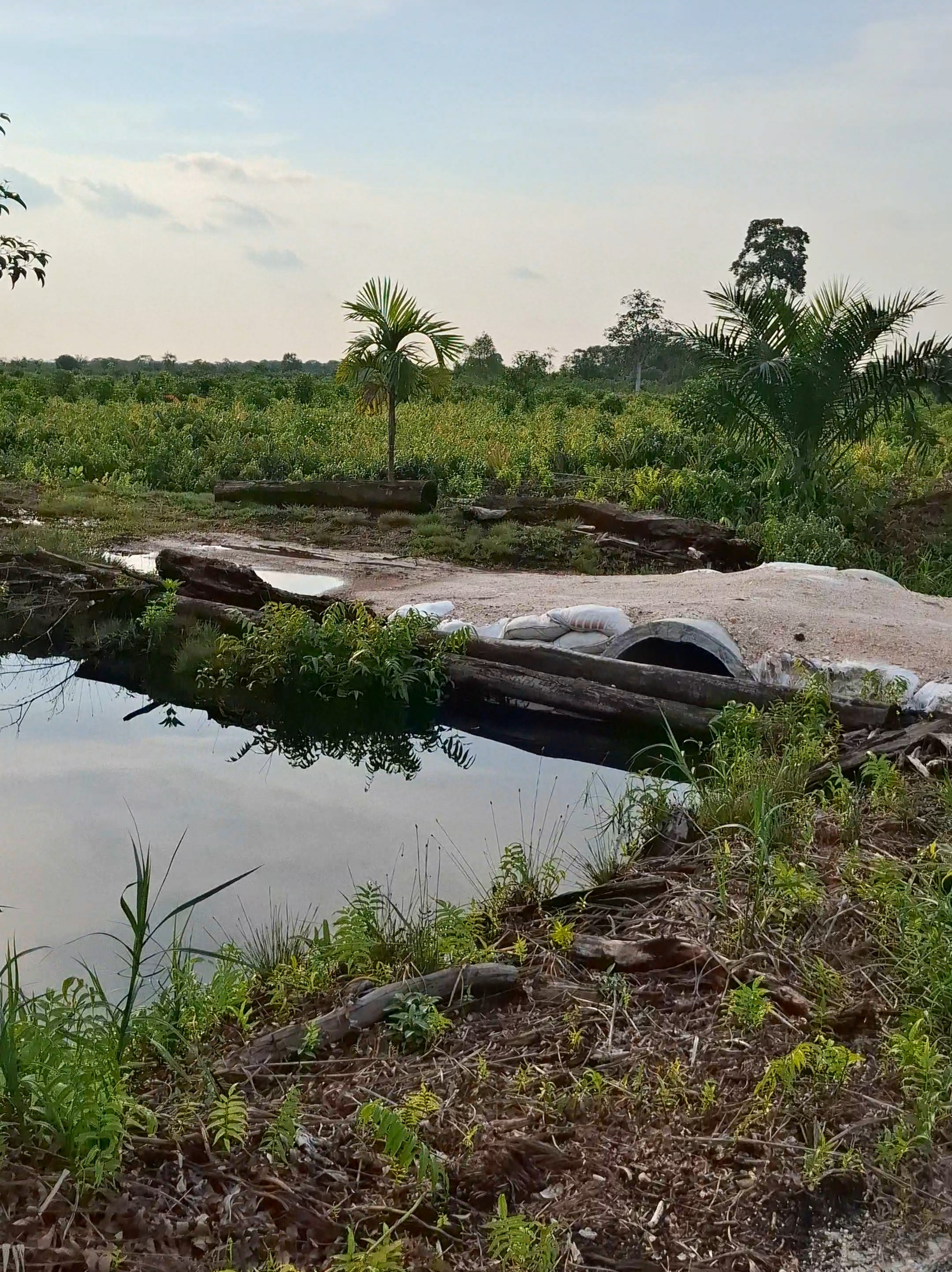 Habitat 3 |
Figure 3: The three habitats surveyed during the expedition.
Most observed localities consisted of fragmented blackwater habitats embedded within agricultural environments: roadside peat depressions, drainage channels, narrow streams, and isolated patches of swamp vegetation between plantation blocks. Some sites had recently been cleared and were reportedly being prepared for urban development. Additional populations were also reported from more intact peat swamp forests, although these areas could not be reached during this expedition.
Habitat 1: A small flowing river
 A |  B |  C |
Figure 4: Habitat 1. A) Stream located within an oil palm plantation. B) Part of the fish diversity collected at the site. C) Parosphromenus phoenicurus from the locality.
Located within an oil palm plantation, a relatively fast-flowing river was home to our first population of P. phoenicurus. We were obviously surprised to find them in the main watercourse, as Parosphromenus are generally not known to inhabit clear, flowing waters. This location was outside of the IUCN range but it was closer than the two other populations visited.
Our contact in Riau brought us to this site. We initially expected to fish the drainage canals connected to the river, but following his advice, we started in the river itself. The fish were not particularly easy to find, although that may have been a question of skill rather than abundance, but they were certainly present.
Unfortunately, the weather was not cooperative. Heavy showers forced us to leave earlier than planned and prevented us from exploring the connected irrigation canals. Rather than risk damaging our equipment, we decided to call it a day.
Water parameters: 25.8°C, pH 5.33, conductivity 22 μS/cm.
Other fish encountered: Pangio sp., Gymnochanda limi, Trichopsis vittata, Sphaerichthys sp., Hemirhamphodon pogonognathus, Betta pugnax, rasboras.
Habitat 2: Drainage canals within a palm plantation
 A |  B |
 C |  D |
Figure 5: Habitat 2. A) Drainage canal within an oil palm plantation. B) Construction site associated with a new toll road crossing the former plantation. C–D) Fish collected from the canal system.
The second locality was situated within a mature oil palm plantation. Part of the plantation had recently been cleared following its purchase for the construction of a toll road. Despite the disturbance, a deep layer of peat was still present and the water was heavily stained with tannins.
Near the construction site, the water was noticeably cloudy, most likely due to sediment runoff from the ongoing works, and P. phoenicurus proved difficult to find. Further into the plantation, conditions appeared much better. The water was clearer, and both P. phoenicurus and other fish species were present in good numbers. Although entirely artificial, these canals still retained many characteristics of peat swamp habitats and supported a diverse fish community.
Water parameters: 28.8°C, pH 3.6, conductivity 64 μS/cm.
Other fish encountered: Kottelatlimia sp., Trigonopoma gracile, Nandus nebulosus, Trichopsis vittata, Kryptopterus sp., Clarias sp., Sphaerichthys sp., Hemirhamphodon pogonognathus, Betta coccina, Luciocephalus pulcher, Betta hipposideros, rasboras.
Habitat 3: Former palm plantation, sold for urban expansion
 A |  B | 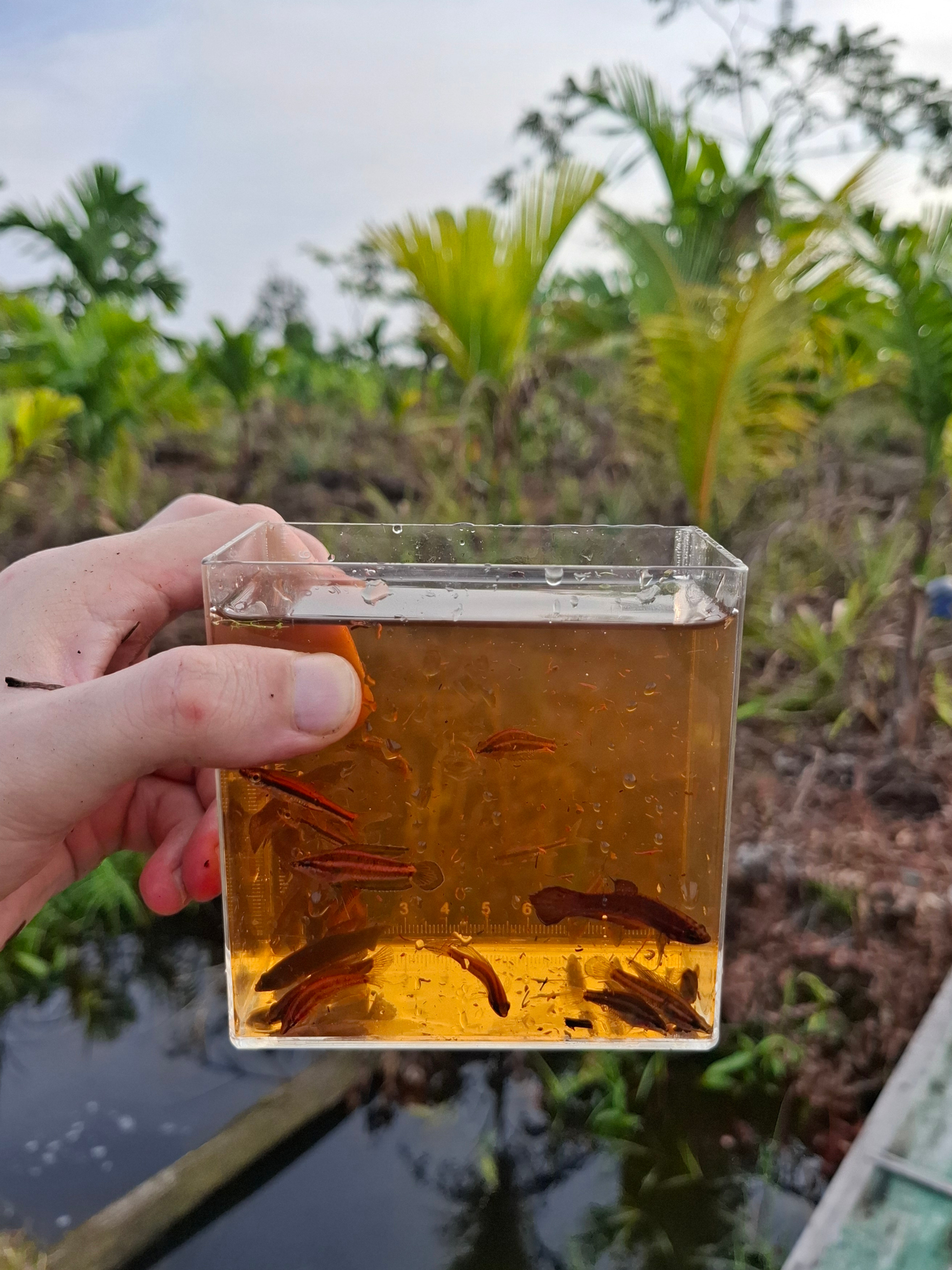 C |
Figure 6: Habitat 3. A&B) Irrigation canals within the former palm plantation with pineapple culture visible. C) Fish collected in a specimen container.
The third locality was located within a former oil palm plantation that had been cleared and sold as housing plots.
The first striking feature was the complete absence of canopy cover and, therefore shade. In the areas that had not yet been modified, a deep peat layer was still present. On plots already sold and under construction, large quantities of limestone had been added to stabilise the ground before building. Areas not yet developed were being used for pineapple cultivation.
The fish were found in the irrigation canals running through what remained of the former plantation. Conditions still appeared favourable for P. phoenicurus. The species was easy to find and juveniles were present, suggesting that reproduction was still taking place.
Nevertheless, the future of this population appears uncertain. The limestone and other fill materials used for construction are likely to affect water quality and may eventually create conditions unsuitable for blackwater species. As development expands across the remaining plots, further habitat degradation seems inevitable.
Of the three localities visited during this expedition, this site was clearly experiencing the greatest pressure and is the one least likely to remain suitable for P. phoenicurus in the long term.
Water parameters: 30.3°C, pH 2.9, conductivity 163 μS/cm.
Other fish encountered: Kottelatlimia sp., Trigonopoma gracile, Nandus nebulosus, Trichopsis vittata, Kryptopterus sp., Clarias sp., Sphaerichthys sp., Betta coccina, Luciocephalus pulcher, Betta hipposideros, rasboras.
Ecological Plasticity and Habitat Tolerance
Despite the heavy disturbance, the habitats surveyed still retained important peat swamp characteristics. Water was generally acidic, weakly mineralised, and stained dark brown by dissolved organic matter. Fish were typically encountered in sections with leaf litter accumulation, submerged roots, and marginal vegetation.
One of the most surprising observations was the discovery of a population inhabiting a relatively clear and moderately flowing stream connected to an oil palm plantation system. Compared to the stagnant blackwater pools usually associated with Parosphromenus, this habitat appeared atypical, with clearer water and stronger current. Nevertheless, peat influence remained evident through acidic water chemistry and the presence of organic materials.
These observations suggest that P. phoenicurus may tolerate a broader range of habitat conditions than previously assumed, provided that some peat swamp characteristics persist. At the same time, the long-term future of these populations remains uncertain. Most observed habitats were small, fragmented, and under immediate pressure from drainage, plantation expansion, and urbanisation.
Rather than demonstrating resilience to habitat destruction, these populations may represent the remaining fragments of a formerly wider distribution surviving in increasingly marginal environments.
Beyond the Kampar System
Another surprising observation deserves mention. We recently received reports of a population resembling P. phoenicurus from the Indragiri River drainage. Although I was unable to visit the locality myself, I had the opportunity to examine photographs and live specimens, and the fish indeed appeared very similar to P. phoenicurus.
If confirmed, this record would considerably extend the known distribution of the species. The Indragiri drainage lies approximately 150 km south of the Sungai Kampar system from which P. phoenicurus was originally described. Furthermore, the two river systems do not appear to be directly connected today.
At this stage, it would be premature to identify these fish with certainty as P. phoenicurus. Nevertheless, their existence raises interesting questions regarding the true distribution of the species and the historical connections between Sumatra's peat swamp systems. It also reinforces a recurring conclusion of this expedition: our current understanding of P. phoenicurus remains far from complete.
Morphological Variation Between Populations
When describing Parosphromenus phoenicurus, Schindler and Linke (2012) emphasised a distinctive colour pattern characterised by vivid red to crimson markings on the unpaired fins, separated by black and iridescent blue bands. In males, the caudal fin was described as having a prominent dark central patch surrounded by a broad red band, followed by an iridescent blue line, a subdistal black band, and a light blue outer margin. The species was also characterised by its rhombic caudal fin shape and a fin formula of D XI–XIII, 6–7 and A XI–XIII, 8–11.

Figure 7: Holotype of Parosphromenus phoenicurus illustrated in the original species description. Photo: Horst Linke.

Figure 8:Male Parosphromenus phoenicurus from the Langgam area, corresponding to the type locality region. Photo: Wentian Shi.
All examined populations could be assigned to P. phoenicurus based on the general morphology and colour pattern described in the original publication. However, noticeable differences were observed between populations, both in colouration and fin morphology.
It should be noted that the photographs presented here were taken with a mobile phone and not under ideal conditions (stressed fish). Therefore, they are not ideal for detailed comparisons. Furthermore, a proper assessment of morphological variation would require the examination of a larger number of specimens and a dedicated morphometric study. The pictures presented are those of males representative of each population.
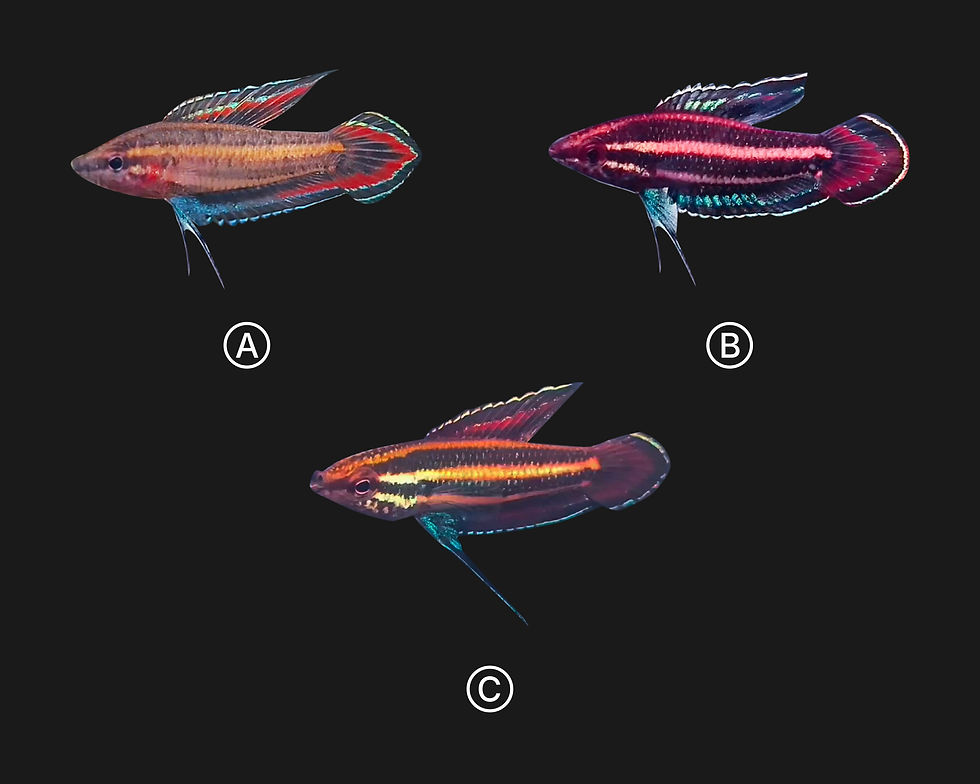
Figure 9: Representative males from populations A, B and C. Differences in caudal fin shape and colour pattern are visible between populations despite their overall similarity to the original description of P. phoenicurus.
The most obvious variation concerns the shape of the caudal fin. In the original description, the caudal fin is described as rhombic. None of the populations examined fully matched this description.
The populations presented in this section do not necessarily follow the order of the habitats described previously. To facilitate comparisons, they are designated here by the letters A, B, and C.
Population | Corresponding Habitat | Relationship to the Type Form |
A | Habitat 2 – Drainage canals within an oil palm plantation | Closest to the original description |
B | Habitat 3 – Former plantation undergoing urban development | Comparable divergence to Population C (caudal fin shape and colouration) |
C | Habitat 1 – Moderately flowing river | Comparable divergence to Population B (mainly colour pattern) |
Table 1. Correspondence between the studied populations and the surveyed habitats.
Population A was the closest, displaying a rhombic caudal fin, although some individuals also showed a central filament extending beyond the fin margin. Population B exhibited a distinctly more rounded caudal fin. This is particularly interesting as populations A and B are separated by only a few kilometres and were probably part of the same peat swamp system before being divided by the construction of a major highway. Population C, located further south, also displayed a rounded caudal fin.
Character | Population A | Population B | Population C |
Caudal fin | Rhombic, occasional filament | Rounded | Rounded, occasionally rhombic |
Dorsal/anal red colouration | Extensive | Limited | Very extensive |
Blue iridescence | Moderate | Extensive | Very limited |
Caudal blue band | Present | Present | Often reduced or absent |
Similarity to original description | Highest | Intermediate | Intermediate |
Table 2: Comparison of key morphological characteristics observed in populations A, B and C.
The differences were not limited to the caudal fin. Differences in colouration were also apparent. Population A was again the closest to the fish illustrated and described by Schindler and Linke (2012). Population B displayed reduced red colouration and a more extensive iridescent blue band on the dorsal and anal fins. In contrast, Population C showed very limited blue iridescence and a greater extent of red colouration on the dorsal and anal fins.
The caudal fin pattern also differed between populations. In Population C, the iridescent blue band separating the broad red band from the subdistal black band appeared to be absent or greatly reduced in some individuals, resulting in a noticeably different appearance from both Population A and the original description.
The variation observed is not random individual variation within a single population. The differences described here were observed repeatedly among fish from each locality and were sufficient to make the populations immediately distinguishable in the field.
Whether these differences represent simple geographic variation, local adaptation to environmental factors, or the result of long-term isolation between peatland systems remains unclear. Nevertheless, they highlight the need for additional field surveys and a more detailed study of populations currently assigned to P. phoenicurus. Given the fragmented nature of peat swamp habitats in Riau and the limited number of populations studied to date, some degree of differentiation between isolated populations is not unexpected.
At present, these observations should be regarded as preliminary. Nevertheless, the differences documented between the populations presented here highlight how little is still known about the variability of P. phoenicurus across its range. Additional surveys, combined with detailed morphological and genetic studies, will be necessary to determine whether these populations represent local variants or a more complex pattern of diversity than currently recognised.
Wider Distribution and Conservation Implications
One of the main outcomes of this expedition is that the current understanding of the distribution of P. phoenicurus is incomplete. The species was found in localities outside the distribution recognised by the IUCN, while reports from local fishermen suggest that it may have disappeared from its historically known range.
At the same time, reports of a population resembling P. phoenicurus from another watershed, the Indragiri drainage, approximately 150 km south of the Kampar system, suggest that the species (or at least closely related forms) may occur over a considerably larger area than currently recognised. Whether these fish belong to P. phoenicurus remains to be determined, but the observation highlights how little fieldwork has been conducted in many peatland systems of central Sumatra.
This situation is not unique to P. phoenicurus. Throughout Southeast Asia, peat swamp habitats are disappearing faster than they can be surveyed, leaving major gaps in our understanding of the species that inhabit them. As a result, current recognised distribution maps likely reflect sampling history more than actual biological limits.
The expedition also demonstrated that populations can persist in highly modified landscapes, including oil palm plantations and fragmented peat habitats. However, all populations encountered remained associated with acidic peat-influenced waters. Their presence should therefore not be interpreted as evidence that habitat degradation is unimportant. On the contrary, the apparent disappearance of populations from historically known localities illustrates the continuing loss of suitable habitat throughout the region.
These observations have direct implications for conservation. First, the true distribution of P. phoenicurus must be clarified through additional surveys. Second, the differences observed between populations highlight the need for detailed morphometric and genetic studies to assess population structure, connectivity, and the taxonomic significance of the observed variation. Such work will be necessary to determine whether these populations represent geographic variants of a single species or a more complex situation than is currently recognised. Third, small and degraded peat fragments should not automatically be dismissed as biologically insignificant. Plantation margins, secondary swamp remnants, and partially altered drainage systems may still support important populations of peat swamp specialists.
At present, it remains impossible to determine which populations are most important for the long-term conservation of the species. The variation observed between populations highlights the importance of preserving multiple peatland systems across the region, as the loss of isolated populations may also result in the loss of unique forms that remain poorly understood. Nevertheless, it seems that the main threat to the three populations described now is urban expansion, as all localities visited during the expedition are located relatively close to Pekanbaru. Establishing this baseline knowledge will be a necessary first step before effective habitat protection and management actions can be implemented.


